Current Status
- The Charleston tract was really marketed as Project Tennessee through Cushman & Wakefield / Revere.
- The Cushman & Wakefield materials pitched a 251-acre site with claims reaching up to 450 MW and up to 3 million gallons per day.
- County leaders said on April 16 and 17, 2026 that no specific filed project had been submitted to Bradley County.
- The April 20 amendment changed the rulebook first. Under the current I-2-only plus 3,000-foot buffer framework, it effectively prevents a project of this scale in Bradley County as presently zoned.
What April 20 Changed
Why the current zoning now leaves very little practical path
I-2 only
The final meeting version effectively confined future data-center and cryptocurrency-mining proposals to Special Impact Industrial zoning.
3,000 feet
The final meeting version added 3,000-foot buffers from FAR, R-1, and R-2 zones, existing homes, schools, and churches.
One current I-2 district
WDEF reported that Bradley County currently has only one I-2 district: the landfill area.
Immediate effect
The amendment took effect right away for future proposals in this category.
Brief Timeline
-
Parcel records show the site had already changed hands
The Tennessee property assessment record shows an April 28, 2025 warranty-deed sale entry on this parcel and lists SDCL TENNESSEE PROP LLC as owner for tax year 2026.
-
Local reporting surfaced an early public hint
The Cleveland Banner reported that a data-center developer had acquired a large site behind Walker Valley High School, while also saying there was no specific commitment to build at that time.
-
County leaders said the rules were not yet on the books
The Cleveland Banner quoted Josh Rogers saying Bradley County had nothing on the books for cryptocurrency, AI, and data-mining centers and should act proactively.
-
County leaders said the county should act before a facility lands
The Cleveland Banner quoted Bently Thomas saying we need to get something on the books before a cryptocurrency mining facility is established and described a draft regulatory model.
-
Planning Commission moved the countywide rulemaking forward
Local coverage showed Bradley County advancing rules related to cryptocurrency mining and data centers months before the April Charleston backlash, with Josh Rogers asking that AI and data centers be named more explicitly.
-
County leaders said no specific project had been filed
The mayor and planning leadership publicly separated countywide rulemaking from approval of a named Charleston project.
-
The commission meeting formally took up the zoning item
The Bradley County Commission page preserves the agenda and video record for the meeting where new data-center and cryptocurrency-mining rules were considered.
-
The final amendment tightened the rules enough to block a Charleston-scale proposal
WDEF reported that the final meeting version tightened the rules to an I-2-only framework with 3,000-foot buffers from FAR, R-1, and R-2 zones, existing homes, schools, and churches, making a project of this scale near impossible under the current resolution.
What Was Marketed
What Cushman & Wakefield pitched
The flyer and listing mattered because they showed a tract being pitched for a very large class of data-center development. They did not by themselves turn that marketing into a filed county project, but they were enough to make the local concern real.
Scale
A hyperscale-tier pitch
The marketed site was not described like a small business server room or a regional edge facility. It was pitched as a campus-scale tract for a much larger class of development.
Brochure Claims
251 acres, up to 450 MW, up to 3 million GPD
Those are the kinds of numbers that made Charleston a serious local issue. They describe a high-impact concept, not an ordinary local facility.
Important Distinction
Marketed site is not the same thing as filed project
The materials showed that a large site was being sold into the market. They did not by themselves create a filed county application, approved utility commitment, or public project record.
Resources
Cushman & Wakefield marketing materials
The image below is the preserved local site image from the Charleston marketing packet. The links beside it collect the preserved copies and outside materials that made the tract a live public issue.
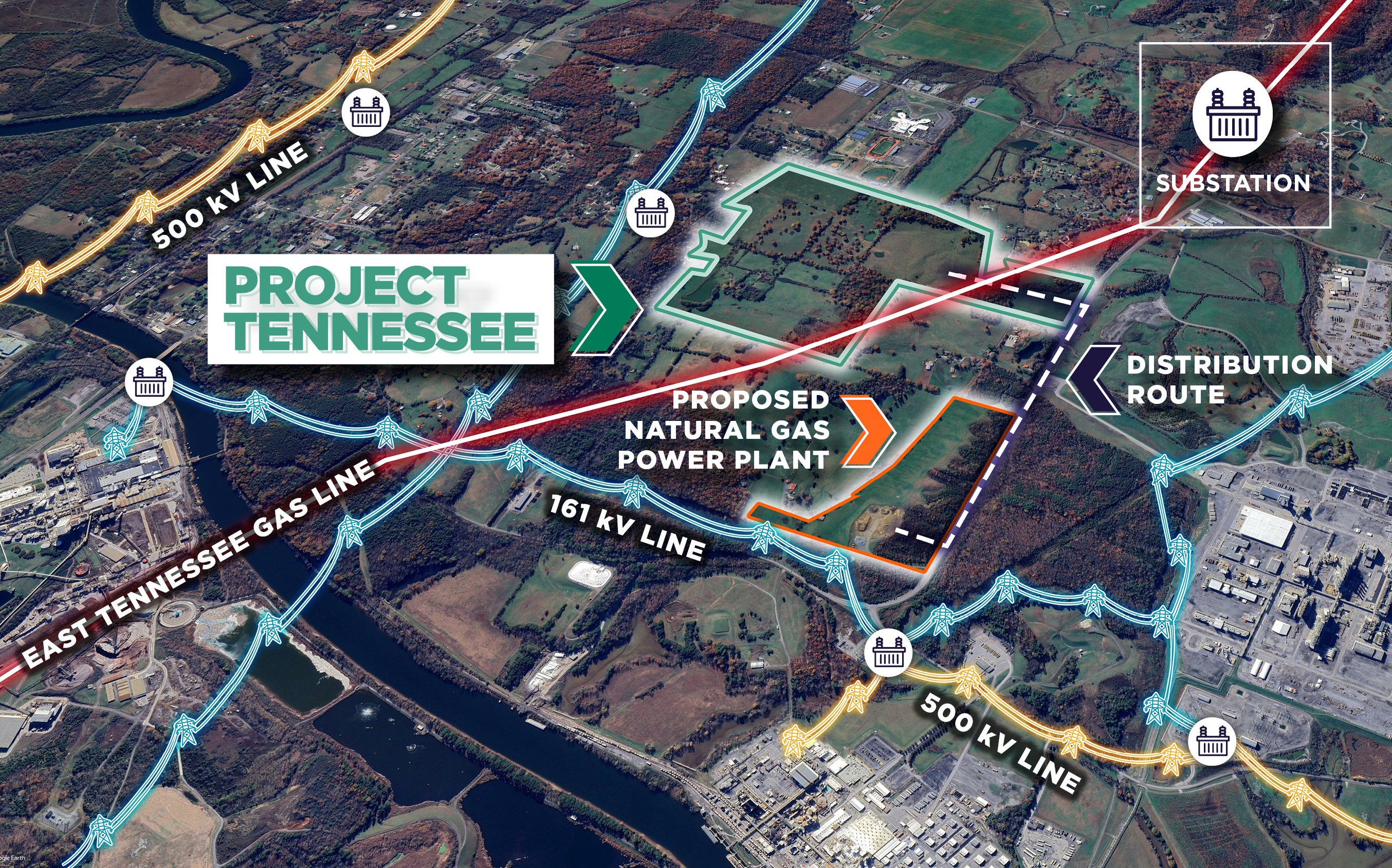
Charleston site image from the marketing packet (preserved local image)
Local preserved copy of the site image used in the Cushman & Wakefield / Revere materials.
Project Tennessee flyer (preserved local PDF)
Local preserved copy of the Charleston marketing flyer.
Project Tennessee Cushman & Wakefield / Revere listing
The external Cushman & Wakefield / Revere project page for the tract.
Project Tennessee flyer (external PDF)
The external Project Tennessee flyer PDF.
The clean read now is straightforward: a Charleston-scale concept was really marketed, the April 20 amendment is really in effect, and under the current zoning framework it effectively prevents a project of that scale in Bradley County.
Sources
- Tennessee property assessment record for the Charleston parcel
- Cleveland Banner report from June 21, 2025
- Cleveland Banner report from September 1, 2025
- Cleveland Banner report from November 22, 2025
- Cleveland Banner report from January 20, 2026
- Local 3 report on the mayor’s April 17 clarification
- Bradley County Commission agendas and video page
- WDEF report on the April 20, 2026 vote
- Charleston site image from the marketing packet (preserved local image)
Local preserved copy of the site image used in the Cushman & Wakefield / Revere materials.
- Project Tennessee flyer (preserved local PDF)
Local preserved copy of the Charleston marketing flyer.
- Project Tennessee flyer (external PDF)
- Project Tennessee Cushman & Wakefield / Revere listing